Kitchen Work Triangle Vs Zone Design: Planning Your Best Layout
Struggling with kitchen bottlenecks? Compare kitchen work triangle vs zone design to find the most efficient layout for your home's unique cooking style.
Author:George EvansFeb 06, 2026671 Shares30.4K Views
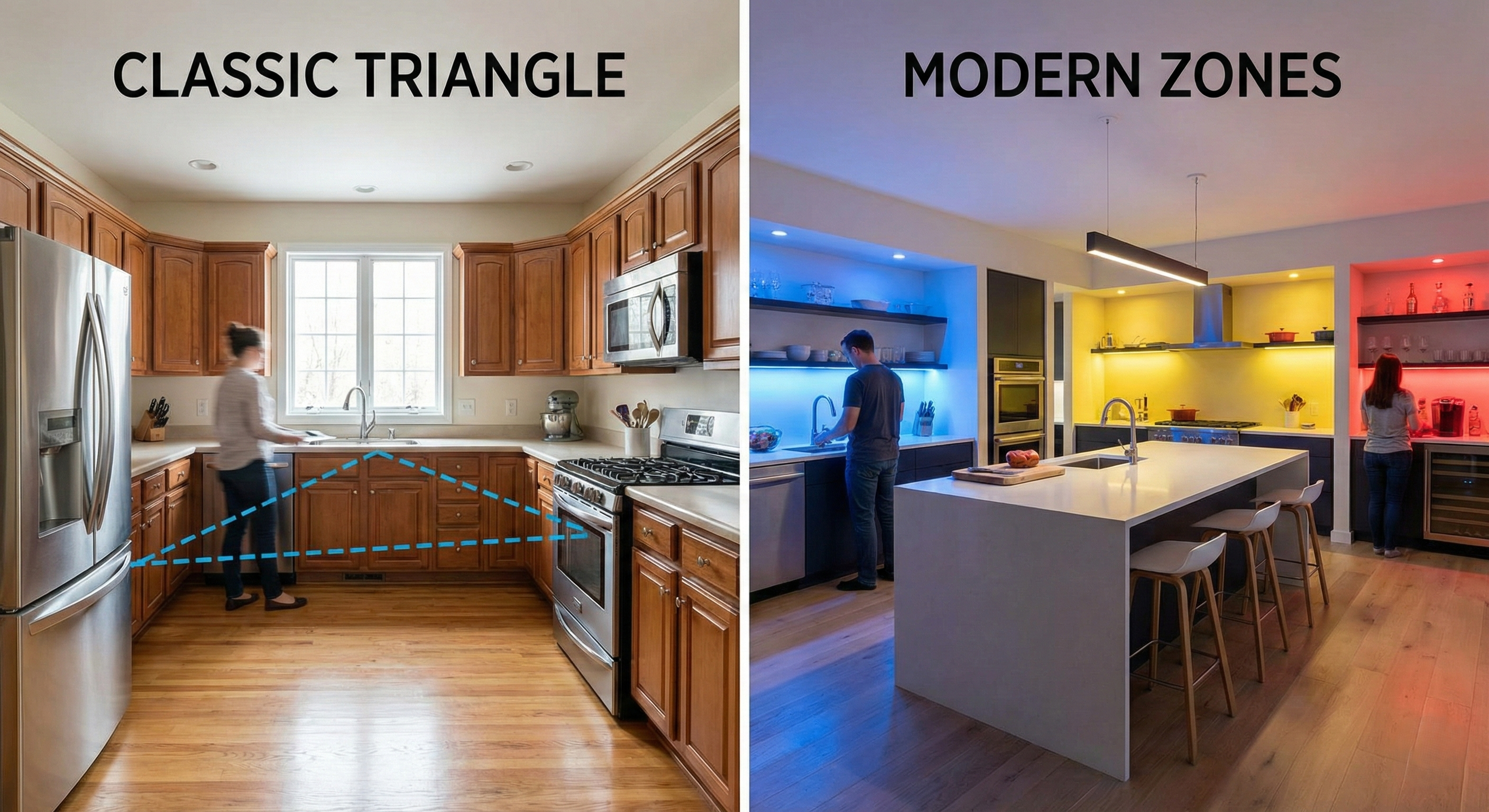
Kitchen Work Triangle Vs Zone Design: Choosing The Most Efficient Layout For Your Home
As an architectural designer, I often tell my clients that a kitchen isn't just a collection of cabinets; it is a choreography of movement.
If you have ever felt the frustration of a bottleneck where the cook and the guest collide near the refrigerator, you are feeling a failure of architectural flow.
My goal is to help you decide whether the rigid efficiency of the classic triangle or the fluid flexibility of modern zones will best serve your home’s unique rhythm.
Movement defines the quality of your daily life. By choosing the right spatial framework, you transform the kitchen from a place of labor into a seamless culinary workshop.
Key Takeaways For Kitchen Planning
- Choose the work triangle when you have one primary cook, a compact layout, and you can keep traffic out of the triangle.
- Choose work zones when you have an island, multiple cooks, or an open plan where people naturally pass through.
- Choose a hybrid when you want the best of both: a tight core triangle for essentials plus peripheral zones (coffee, baking, serving) off the main path.
- Validate any plan with two non-negotiables: triangle distance rules (if using a triangle) and aisle/clearance rules (for safety and comfort).
The Legacy Of Efficiency: Understanding The Kitchen Work Triangle
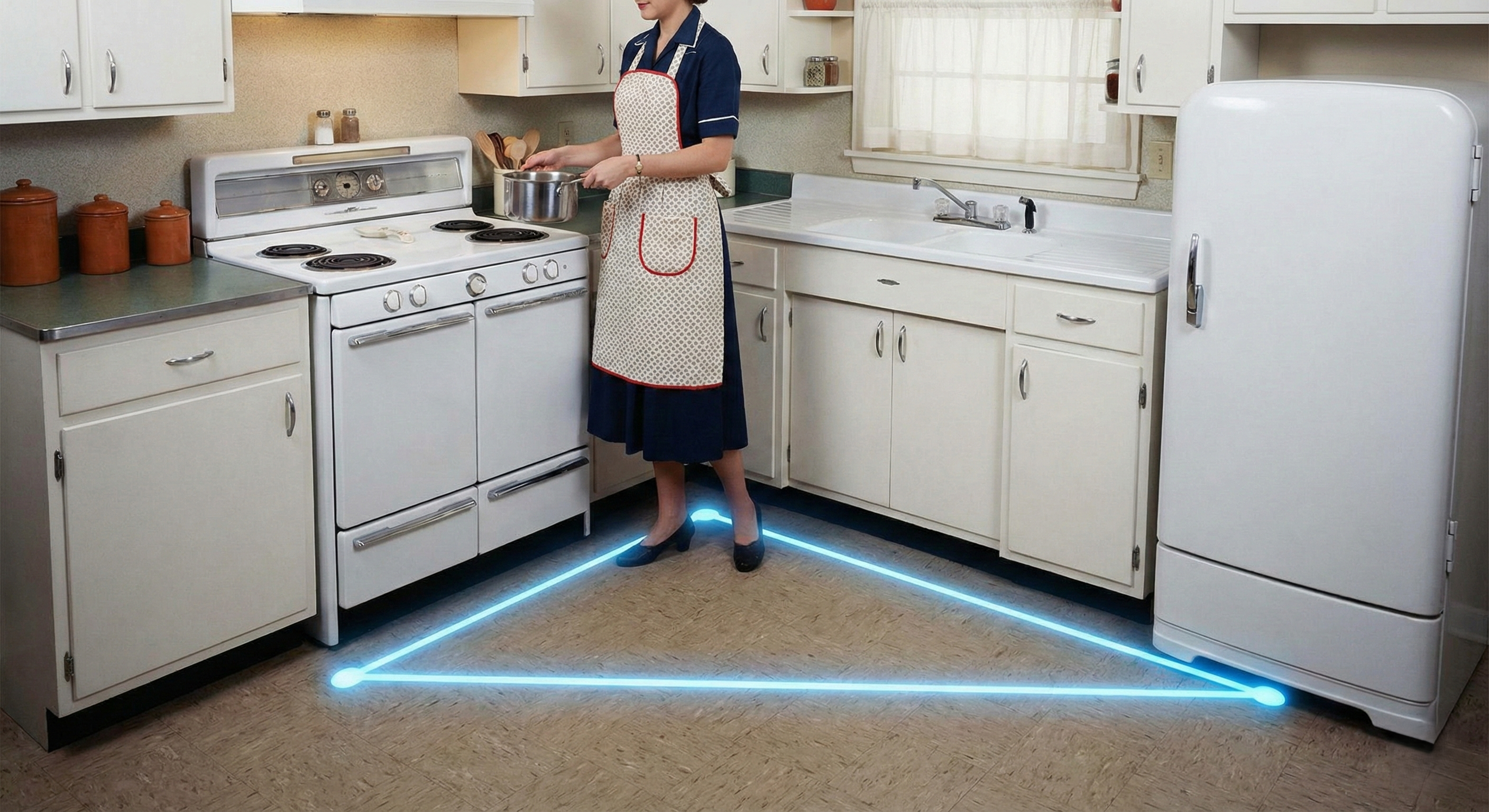
The kitchen work triangle was born in the 1940s at the University of Illinois School of Architecture.
At its core, it is an industrial efficiency tool designed to save the homemaker steps by connecting the three most high-traffic points: the sink, the refrigerator, and the range.
The 4-To-9 Foot Rule: The Ergonomics Of The 1940s
For a triangle to be effective, each leg should measure between 4 and 9 feet. The sum of all three legs should not exceed 26 feet.
If the points are too close, the kitchen feels cramped; if they are too far apart, the act of preparing a simple meal becomes an exhausting hike.
These dimensions ensure that the pivot point of the cook remains central and minimizes wasted energy.
When The Triangle Still Wins: Small Spaces And Galley Layouts
In a small Manhattan apartment or a compact suburban galley kitchen, the triangle is still the undisputed champion.
When square footage is a premium, the simplicity of three points ensures that everything is within a chef’s reach. It prevents the spread of activity into areas where it isn't needed, keeping the workspace focused and intense.
Illustrative Scenario: Solo Cook In A Compact Kitchen
Jordan cooks most nights in a modest L-shaped kitchen. The fridge is at one end, the sink sits centered under a window, and the cooktop is on the adjacent run. Jordan’s biggest complaint is too many steps.
When Jordan measures center-front to center-front, each leg lands between 5 and 7 feet, totaling under 20 feet.
There’s no island, and the entry path skirts the outside of the L, so traffic never cuts through the triangle. The result isn’t trendy; it’s calm, consistent movement.
Takeaway:When a kitchen is compact and protected from through-traffic, the triangle is still one of the cleanest ways to buy speed and simplicity.
The Modern Pivot: Why Zone Design Is Taking Over
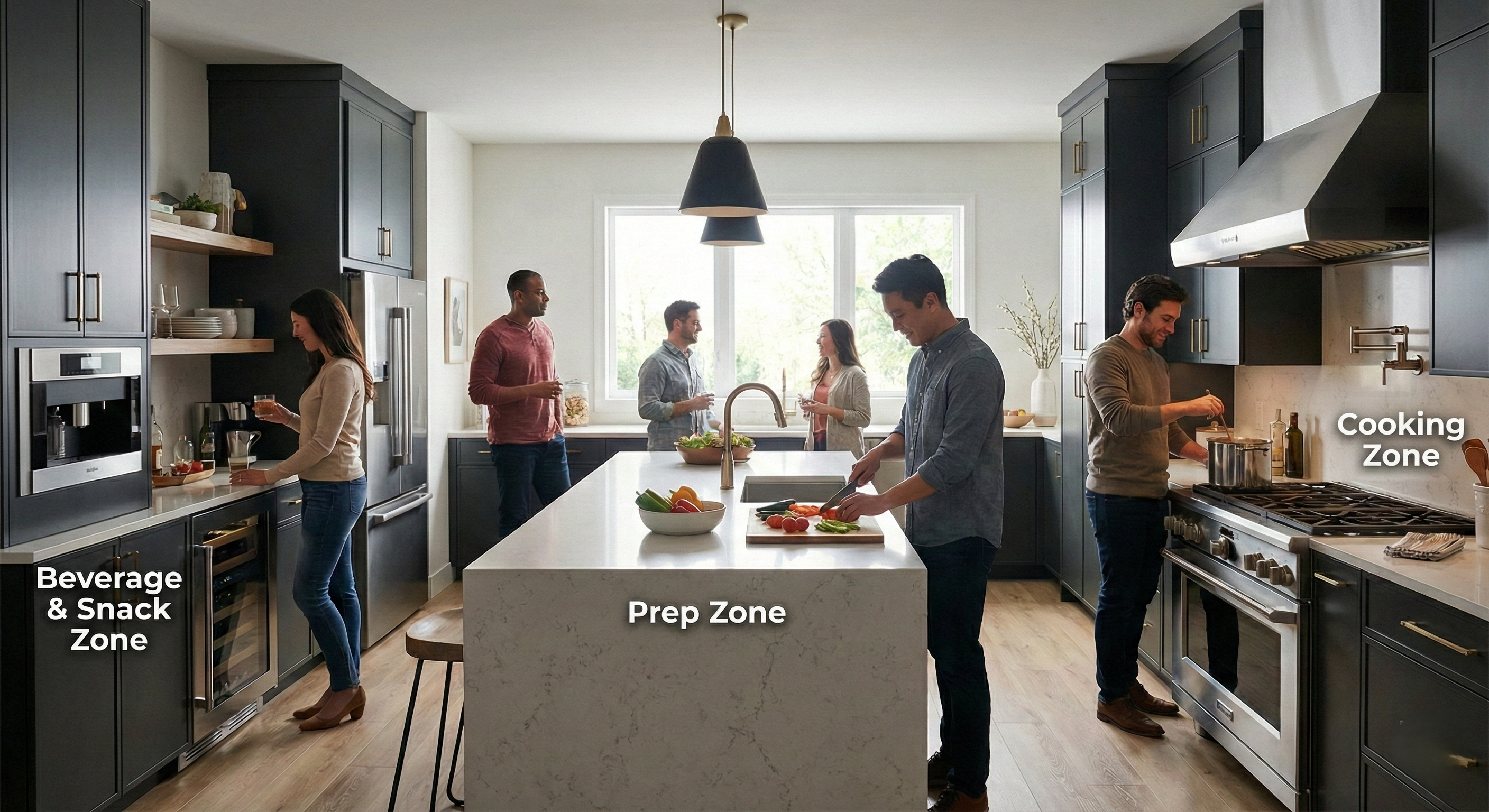
Architecture must evolve as behavior evolves. The living kitchen of the 2020s is no longer a hidden room for a solo laborer; it is a social hub, a homework station, and a multi-chef laboratory.
This is where zone design excels by breaking the kitchen into functional workstations that operate independently.
Beyond The Three Points: Accommodating The Living Kitchen
Zone design allows for specialized areas that the traditional triangle ignores. Think of the Coffee Station or the Kids' Snack Zone.
By grouping the microwave and the snack pantry away from the main cooking area, you allow others to access food without crossing the primary chef's path. It is about de-conflicting the space.
The Five Essential Workstations: Prep, Cook, Clean, Consumables, And Non-Consumables
A well-zoned kitchen typically follows the Blum Dynamic Space model, which organizes the room into five distinct areas.
The Consumables Zone (fridge/pantry) should be near the entrance for easy unloading. The Prep Zone requires at least 36 inches of unobstructed counter space, ideally between the sink and the stove.
Transitioning from a triangle to a zone-based system is the key to managing a busy, multi-person household without the stress of constant collisions.
4-Zone Vs 5-Zone Models
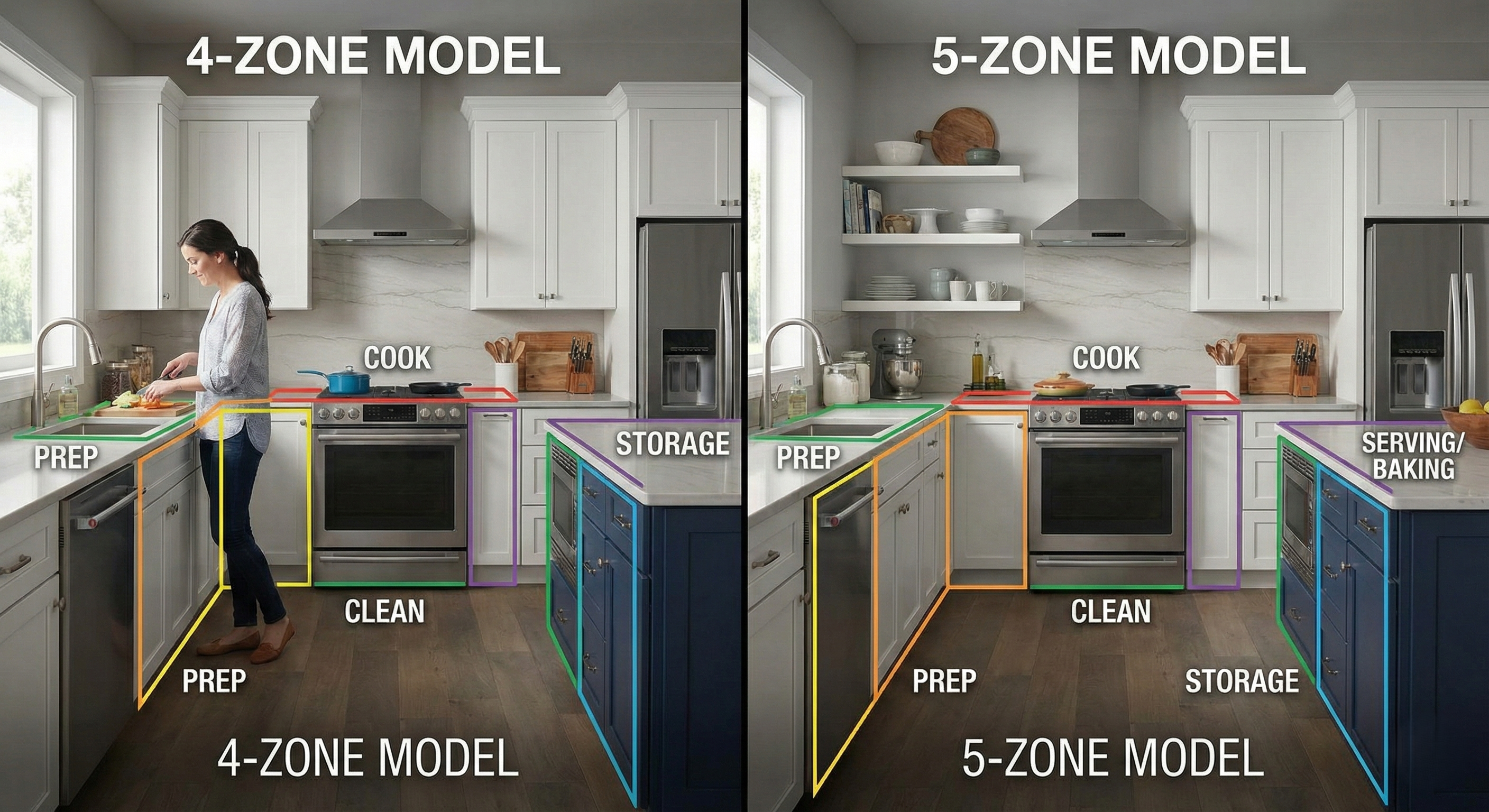
A 5-zone model often splits storage into consumables (pantry/fridge) and non-consumables (cookware, dishes, small appliances). That can help when storage is spread across a large footprint.
If your kitchen is smaller, a simpler 4-zone model usually wins. Too many zones can become a labeling exercise instead of a layout strategy.
Illustrative Scenario: Family Kitchen With Kids And Guests Passing Through
Mina and Theo cook together, and their kids do homework on the island. Guests enter from the living room and naturally drift toward the snacks.
A triangle attempt puts the sink on the island, the cooktop on the back wall, and the fridge near the pantry, technically triangle-ish, but the island leg becomes the main hallway.
Instead, zones create boundaries: the island becomes prep + homework, the back wall becomes cooking, and a beverage zone moves to the edge so guests can help themselves without stepping into the prep area.
Takeaway:Zones shine when your kitchen is also a social space, because they control crossings and protect the work surface.
The Hybrid Layout: Core Triangle And Peripheral Zones
Most kitchens don’t need to choose a side. They need a clear hierarchy: a tight core for daily cooking, and dedicated edges for everything else.
The hybrid approach keeps the triangle’s efficiency where it’s still true, and uses zones to handle modern realities.
What Stays In The Core Triangle
Keep in the core:
- primary fridge access
- primary sink access
- primary cooktop access
- the most-used landing/prep area
Move out to peripheral zones:
- coffee/beverage
- baking tools and stand mixer parking
- serving platters and glassware
- secondary pantry overflow
- microwave
This is how you avoid the everything on the island trap: the island becomes a deliberate zone, not a catch-all.
How To Place Secondary Zones Without Creating Bottlenecks
Two placement principles tend to prevent regrets:
- Keep the core triangle protected from through-traffic.
- Put guest-facing zones on the perimeter, so help doesn’t become interference.
If the coffee machine requires standing in the prep aisle, it’s not a coffee zone; it’s a daily blockage.
Illustrative Scenario: Two Cooks + Island + Coffee Bar
Ravi and Sam cook side by side. The island is large enough for prep, but it also has seating. They add a coffee station on a tall cabinet wall near the dining area, so mornings don’t start with someone hovering over the cutting board.
The core triangle stays tight:fridge → sink → cooktop, and the island is primarily prep/serving. The coffee bar becomes a self-contained zone with mugs, beans, and a small sink nearby, eliminating cross-kitchen scavenger hunts.
Takeaway:A hybrid plan often feels the most luxurious because it reduces friction without forcing the kitchen into a single theory.
Architectural Standards: Dimensions And NKBA Guidelines
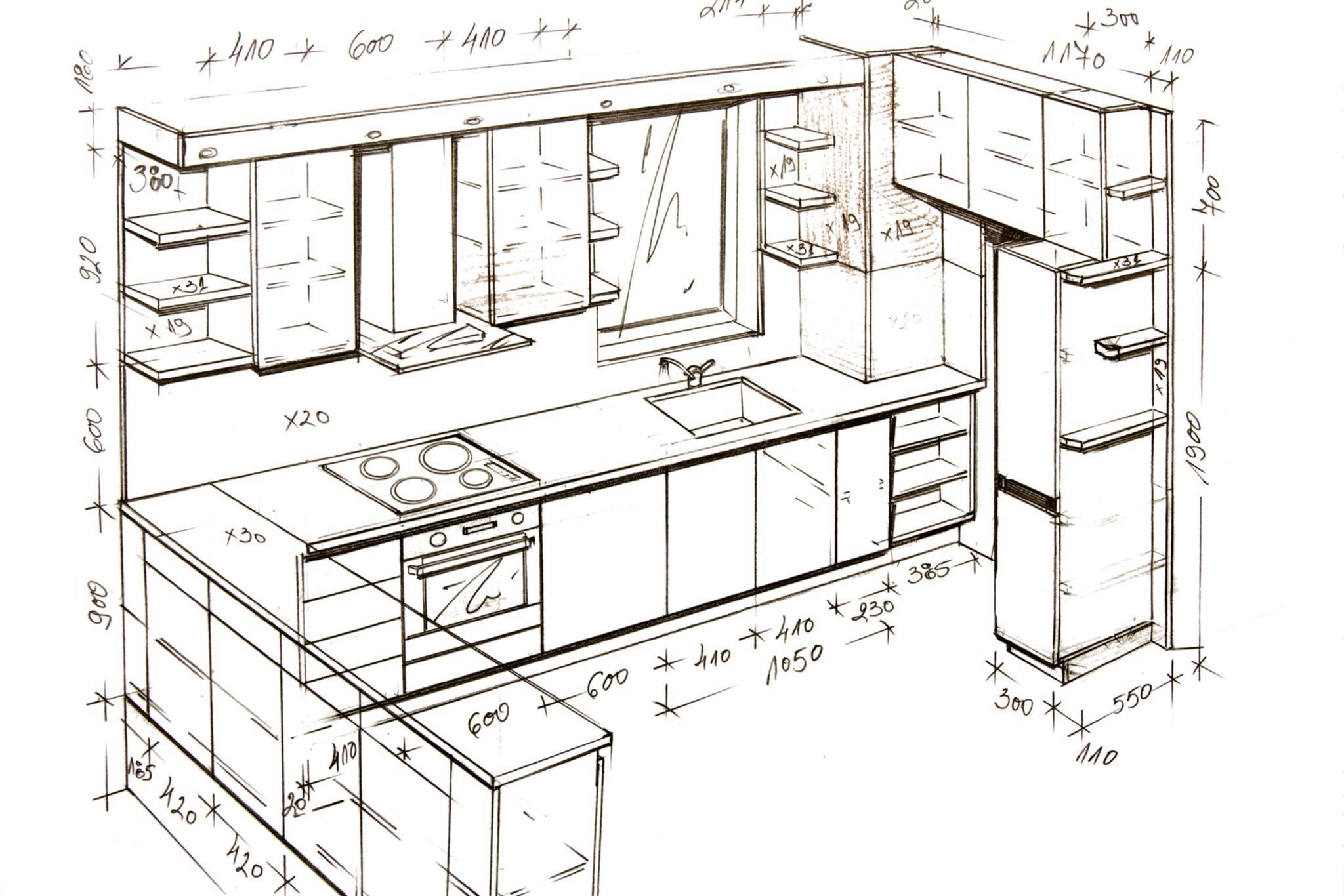
Designing a high-performance kitchen requires adhering to the National Kitchen & Bath Association (NKBA)standards. These are not mere suggestions; they are the empirical data of human ergonomics and safety.
Landing Area Requirements: The Unsung Heroes Of Safety
A landing area is the counter space next to an appliance. According to NKBA guidelines, a refrigerator needs at least 15 inches of landing space on the handle side.
A cooktop requires 12 inches on one side and 15 inches on the other. Without these, you are forced to carry hot or heavy items across the room, which is a major safety risk.
Traffic Lanes: Avoiding The Bumping Elbows Effect
In my practice, the most common mistake is narrow walkways. For a truly functional zone-designed kitchen, the Work Aisle should be 42 inches wide.
If you have two people working simultaneously, 48 inches is the absolute minimum. This allows one person to pass behind another without the excuse me shuffle.
The Layout Decision Matrix
| Criteria | Recommended Layout |
| Kitchen Size < 100 sq ft | Kitchen Work Triangle |
| Multiple Daily Cooks | Zone Design |
| Open-Plan / Island Centric | Zone Design |
| Single Wall / Galley | Kitchen Work Triangle |
Following these technical thresholds ensures that your kitchen isn't just beautiful, it is structurally sound for the human body.
The Traffic Lane Safety Checklist
- Work aisles are at least 42 wide (48 for two cooks).
- No leg of the work triangle is obstructed by an island or cabinetry by more than 12.
- The refrigerator landing area is within 48 inches of the appliance.
- Trash and recycling are located in the Prep or Cleanup zone.
- The microwave is placed outside the primary cooking triangle for guest access.
By respecting these dimensions, you ensure the longevity of your design and the safety of everyone who uses it.
A Step-By-Step Method To Plan Your Layout In 30 Minutes
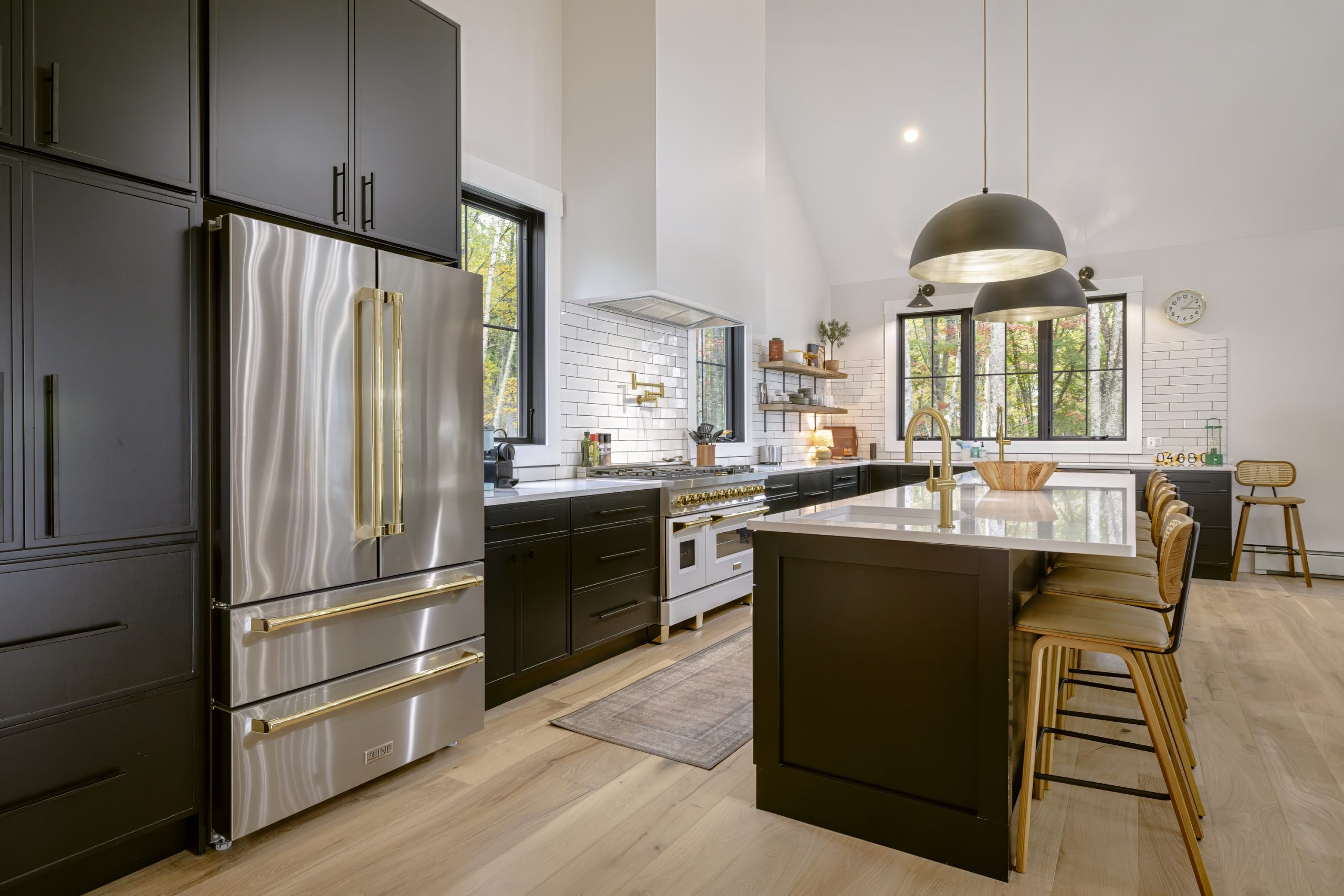
If you want a layout decision you can defend to a contractor, a designer, or your future self, use a quick workflow map and a measurement sanity check.
This method works whether you’re remodeling or simply reassigning cabinets.
Step 1: Write Your Daily Workflow
List 5–8 common routines: weekday dinner, school lunch, coffee, and hosting. For each routine, write the sequence in plain verbs.
Example: unpack groceries → pantry/fridge → wash produce → chop → cook → plate → load dishwasher.
Patterns will show up fast. Those patterns are your true requirements, not the Pinterest layout.
Step 2: Assign Zones And Adjacency
Now decide which items must live together:
- knives + boards near prep
- oils/spices near cooking
- plates near the serving
- trash near prep and sink
This is where zone design becomes practical: you’re planning adjacency, not furniture.
Step 3: Validate Clearances
Clearances are the invisible architecture of comfort. In my practice, I’ve seen that a kitchen’s success isn’t measured by the stone on the counters, but by the math of the aisles.
Start with the NKBA (National Kitchen & Bath Association) work aisle guidance as your baseline, but adjust for the modern reality of the social kitchen:
- 42 Inches The Solo Minimum:This is the baseline for a single cook to operate without feeling boxed in.
- 48 Inches The Multi-Cook Standard:If you and your partner share the choreography, 48 inches allows you to pass back-to-back without the excuse me shuffle.
- 54 Inches The Luxury Social Aisle:In 2026, we are increasingly pushing to 54 inches for aisles featuring island seating. This ensures that even when a guest is seated and pushed back from the counter, a cook can move behind them with a hot tray comfortably and safely.
A high-performance kitchen should also consider Universal Design, not just for mobility needs, but because it makes the space feel more open and effortless for everyone.
The Access Board ADAguidelines recommend 30 × 48 minimum clear floor space at major elements (sink, refrigerator, range) so each station feels usable without crowding.
Going further, providing at least one 60 diameter clear turning circle supports an easy full turn, preventing the constant three-point turn shuffle.
Step 4: Stress Test With A Real Scenario
Run three simulations:
- One person cooking
- Two people cooking
- Guests entering and hovering
If the path to the fridge cuts through the main prep zone, you’ll feel it every day. If the dishwasher door blocks the only aisle, you’ll resent it forever.
Expert’s Take:Choose your model in 10 minutes
- Can you keep major traffic out of the cooking workflow?
- Is there one primary cook most days?
- Do you have an island that people naturally circle?
- Do you have more than three primary work centers, e.g., prep sink, wall oven stack, beverage fridge?
- Do you need 42–48 inches of work aisle to avoid crowding?
Rule of thumb:More yes answers on the right side of the island, multiple cooks, many centers, heavy traffic push you toward zones or a hybrid.
Takeaway:A good layout decision is a mix of habit mapping and measurable clearance checks, not loyalty to a single design slogan.
Food Safety And The Hidden Workflow Most Layouts Ignore
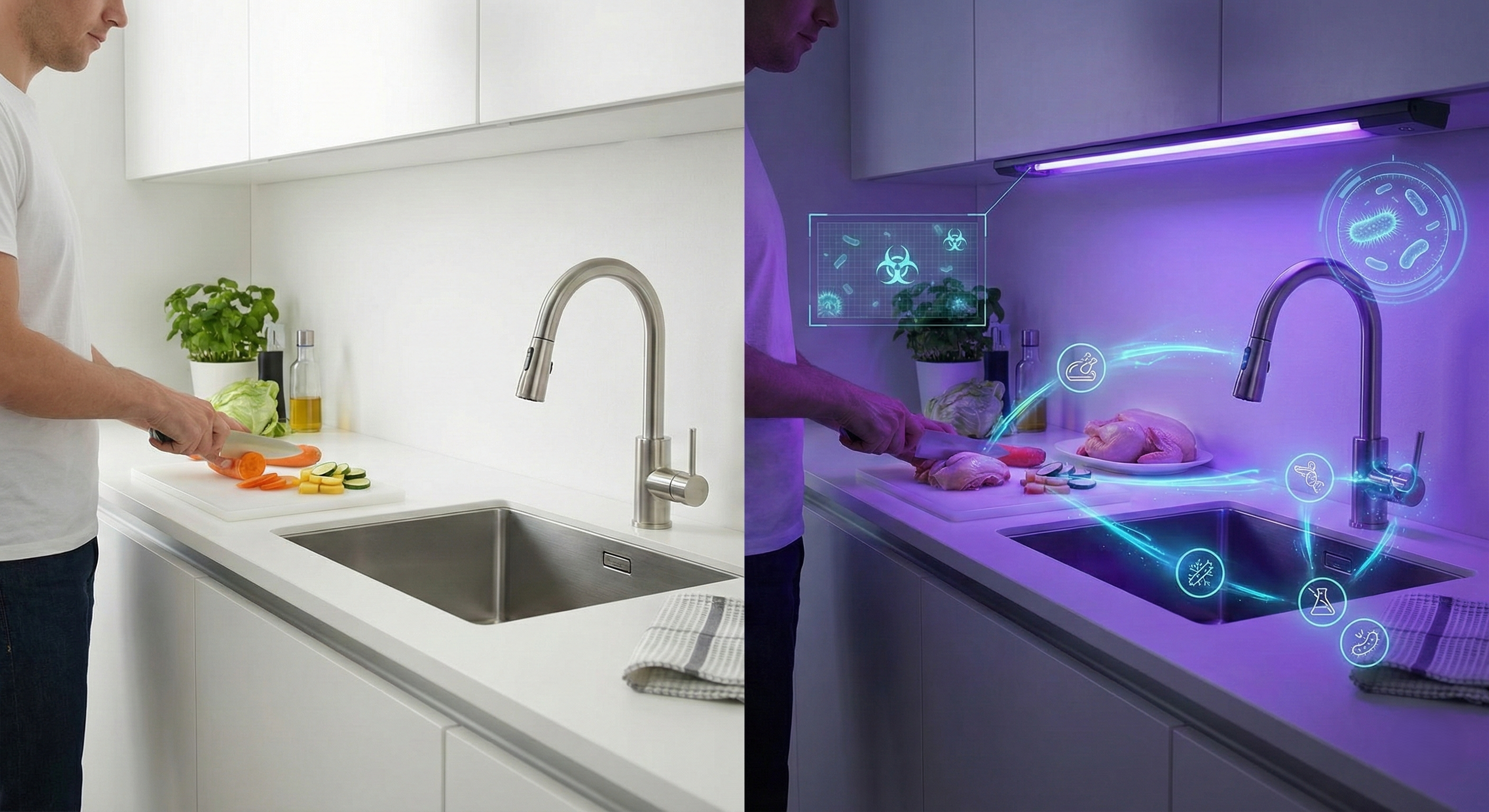
Most kitchen layout conversations talk about efficiency. Fewer people talk about hygiene even though it’s part of how kitchens are used, especially around the sink and prep area. This isn’t about fear; it’s about acknowledging that workflow influences habits.
Sink-To-Work-Surface Proximity And Why It Can Matter
A peer-reviewed study examining kitchen layouts and food hygiene practices found associations between cross-contamination events and longer sink-to-countertop distances, and it proposed a food safety triangle concept emphasizing close sink–workplace placement.
You don’t need a new design buzzword to benefit from the insight. The practical takeaway is simple: make handwashing easy during prep by keeping the primary work surface close to the sink.
Practical Hygiene-Minded Tweaks Without Overhauling The Whole Plan
- Put your primary prep surface adjacent to (or very near) the sink.
- Store towels, soap, and trash where they support a clean prep sequence.
- If you have a large island, consider whether the sink placement encourages frequent washing or just makes the sink a social obstacle.
Takeaway:A kitchen that supports easy handwashing during prep can be both more pleasant and more sensible without changing your entire layout philosophy.
Breaking The Monolith: The Rise Of Decentralized Appliances
The biggest disruptor to the classic Work Triangle in 2026 is the disappearance of the single, monolithic appliance. We are seeing a shift toward Point-of-Use Refrigeration and specialized cooking nodes that allow the kitchen to breathe.
Point-Of-Use Refrigeration
Instead of one giant refrigerator that acts as a traffic magnet, we now utilize Decentralized Cooling:
- The Prep Drawer:A refrigerator drawer located directly under the island prep surface for greens and perishables.
- The Refreshment Station:A dedicated beverage fridge located on the outer perimeter, allowing guests to grab a drink without ever entering the cook’s Core Triangle.
Specialized Cooking Nodes
The traditional range is being supplemented (or replaced) by specialized appliances that demand their own zones.
- The Health Station:With the 2026 surge in steam and combi-oven usage, many designs now feature a Secondary Cook Zone dedicated to oil-free, health-focused preparation.
- The Impact on Layout:This decentralization effectively kills the Rigid Triangle. Instead, we create Micro-Triangles, small, efficient loops between a specific appliance (like the steam oven) and its nearest landing/sink area.
Architect’s Tip:When you decentralize appliances, you must be careful not to fragment the kitchen.
Ensure each micro-zone has dedicated storage for tools used only in that area (e.g., mugs and spoons at the coffee station, baking sheets at the steam oven).
The 2026 Wellness Sidebar: Designing For Hygiene And Health
In my practice, the Wellness Kitchen is no longer a niche request; it is the standard for 2026. We are moving beyond simple efficiency toward a layout that actively promotes health and reduces cross-contamination.
The Clean-To-Dirty Workflow
Modern zone design now prioritizes a strict directional flow. Raw food should enter the Prep Zone, move to the Wash Zone, and finally to the Cook Zone without ever backtracking.
This linear progression is the single most effective way to prevent the spread of foodborne pathogens.
The Secondary Hand-Wash Sink
If your floor plan allows, a dedicated, touchless hand-washing station near the entrance prevents outside germs from reaching your primary food surfaces.
Ventilation As A Zone Attribute
Don't just place the range where it looks good. The Cook Zone should be planned around high-performance extraction.
In 2026, we design Air Quality Zones by ensuring high-Btu appliances are positioned to maximize cross-ventilation and hood efficiency, keeping VOCs and fine particulate matter out of the living areas of the kitchen.
Also Check Out: quartz vs granite countertops pros and cons
Frequently Asked Questions
Why Is The Kitchen Triangle Outdated?
It’s not universally outdated, but it assumes one cook and three key points. Islands, extra appliances, and open-plan traffic often add conflicts that the triangle doesn’t model well.
Is The Kitchen Work Triangle Ergonomic?
Often, yes, in compact, one-cook kitchens, especially when triangle distances are reasonable, and traffic stays out of the work area.
What Is The Distance Of The Kitchen Triangle?
NKBA recommends the three traveled distances total no more than 26 ft, with each leg 4–9 ft, measured from the center-front of each work center.
What Is The 3 Kitchen Rule?
It’s common shorthand for the big three work centers: sink, cooking surface, and refrigeration, arranged to reduce unnecessary steps during cooking.
What Is The Triangle Method In The Kitchen?
It’s a layout principle that links sink, cooktop, and fridge in a workable triangle to streamline the main cooking loop and reduce travel.
What Is The Golden Rule Of Kitchen Design?
Protect workflow: keep traffic out of work areas, maintain safe clearances, and place landing/prep space where tasks actually happen.
What Are The Work Zones In A Kitchen?
They’re task-based areas commonly prep, cooking, cleaning, and storage, often expanded with beverage, baking, or serving zones when those routines are real.
What Is The Zone System For Kitchens?
It’s a planning approach that groups tools, storage, and surfaces by task sequence so multiple people can work without constantly crossing paths.
What Are The Three Zones Of The Kitchen?
Many people simplify to prep, cook, and clean. Storage and serving zones are often added depending on kitchen size and household routines.
Is Zone Design Better For An Island Kitchen?
Often, yes, because islands become multi-purpose hubs. Zones help prevent the island from turning into a traffic choke point during cooking.
When Is The Work Triangle Still Best?
It’s strongest in small-to-medium kitchens with one primary cook and a circulation path that doesn’t cut through the triangle.
Can You Combine The Work Triangle And Zones?
Yes. A common approach is a compact core triangle for essentials, with secondary zones (coffee, baking, serving) placed off the main traffic path.
How Do You Plan Zones Step-By-Step?
List your routines, group tools by task, place zones in sequence, then verify aisle widths and keep traffic out of key work areas.
Do Triangle Rules Account For Food Safety?
Not directly. Research suggests sink-to-work-surface distance can influence hygiene behavior, which is why some researchers propose food safety triangle thinking.
How Do Accessibility Needs Change The Best Layout?
Clear floor space and maneuvering needs can favor wider aisles and clearer zone separation, especially in tight U-shapes and dead-end paths.
Conclusion
Choosing between the kitchen work triangle and zone design is not about following a trend; it is about an honest assessment of how you live.
If you are a solo enthusiast who enjoys the focus of a tight, efficient space, the triangle remains a masterclass in ergonomics.
If your kitchen is the command center of a busy family, zone design will provide the breathing room you need to stay sane during the morning rush.
In my twenty years of architectural practice, I have found that the most successful kitchens are those that respect human movement.
Start with the rules of the triangle to ensure core efficiency, then expand into zones to accommodate your life. When you get the architecture of movement right, every meal feels like a performance rather than a chore.
Jump to
Kitchen Work Triangle Vs Zone Design: Choosing The Most Efficient Layout For Your Home
Key Takeaways For Kitchen Planning
The Legacy Of Efficiency: Understanding The Kitchen Work Triangle
The Modern Pivot: Why Zone Design Is Taking Over
The Hybrid Layout: Core Triangle And Peripheral Zones
Architectural Standards: Dimensions And NKBA Guidelines
A Step-By-Step Method To Plan Your Layout In 30 Minutes
Food Safety And The Hidden Workflow Most Layouts Ignore
Breaking The Monolith: The Rise Of Decentralized Appliances
The 2026 Wellness Sidebar: Designing For Hygiene And Health
Frequently Asked Questions
Conclusion

George Evans
Author
George Anderson, an exceptional architectural designer, envisions and brings to life structures that transcend the realm of imagination. With an unwavering passion for design and an innate eye for detail, George seamlessly blends form and function, creating immersive spaces that inspire awe.
Driven by a deep appreciation for the interplay of space, light, and materials, George's innovative approach redefines the possibilities of architectural design. His visionary compositions leave an indelible mark, evoking a sense of wonder and transforming the built environment.
George Anderson's transformative designs and unwavering dedication continue to shape the architectural landscape, pushing the boundaries of what is possible and inspiring generations to come.
Latest Articles
Popular Articles