Handrail Vs Guardrail Residential Difference: Design & Compliance
Stop confusing support with containment. Understand the critical height and grip codes defining the handrail vs guardrail residential difference to avoid inspection failures.
Author:George EvansFeb 08, 20262.2K Shares57.7K Views
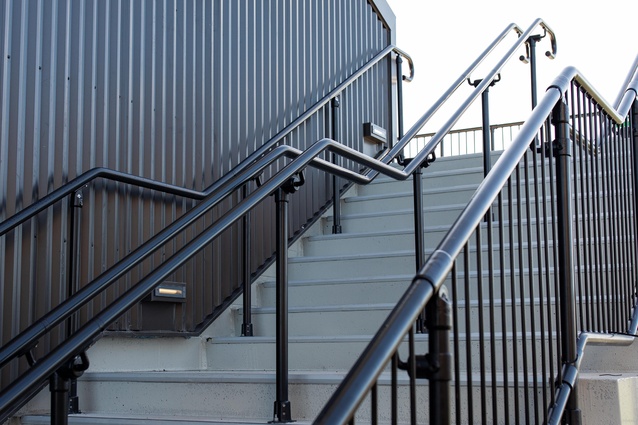
Support Vs. Containment: Understanding Handrail Vs. Guardrail Differences
In my two decades as an architectural designer, I have seen countless homeowners-and even some contractors stand baffled when a building inspector flags a stunning new staircase as non-compliant.
The confusion almost always stems from a single misunderstanding: treating handrails and guardrails as interchangeable terms. They are not.
While both features contribute to safety, they serve fundamentally different purposes in residential design.
A handrail is for your hand; it provides support and guidance. A guardrail is for your body; it provides containment and prevents falls from height.
Understanding this Support vs. Containment distinction is the key to creating staircases that are not only architecturally beautiful but also safe and code-compliant.
Key Takeaways
- Function:Handrails are for grip and balance on slopes (stairs). Guardrails are for barriers on elevated edges (landings/balconies) to stop you from falling over the side.
- Height Rules:Handrails must be 34–38 high, measured from the stair nosing. Guardrails must be at least 36 inches high, measured from the floor.
- Graspability:Handrails require a specific shape that your hand can firmly wrap around. Guardrails have no grip requirement; their top rail can be wide, flat, or purely decorative.
- The Hybrid:A guardrail can serve as a handrail only if its top rail meets the specific height and graspability rules of a handrail.
Quick Reference: Handrail Vs. Guardrail Standards
To simplify the specific requirements of the International Residential Code(IRC), I have broken down the critical distinctions below.
While the code books can be dense, the difference essentially comes down to function: are you trying to hold onto something, or are you trying to stay inside something?
Use this side-by-side comparison as your field checklist when planning a renovation or inspecting a new staircase.
| Handrail (Support) | Guardrail (Containment) |
| Primary Purpose: Designed to provide grip, stability, and guidance for the human hand while ascending or descending stairs. | Primary Purpose: Designed to act as a physical barrier to prevent people (especially children) from falling over the edge of an open side. |
| Residential Height (IRC): Must be installed between 34 inches and 38 inches vertically from the stair nosing. | Residential Height (IRC): Must be a minimum of 36 inches vertically from the finished floor (higher is allowed). |
| Graspability: Strictly required. Must have a specific cross-section (Type I or Type II) that allows a hand to firmly wrap around it for safety. | Graspability: Not required. The top rail can be flat, wide, or purely decorative (like a shelf), as long as it meets strength requirements. |
| Where to Measure: Measured vertically from the sloped plane of the stair nosing (the front edge of the tread). | Where to Measure: Measured vertically from the flat finished floor or the line of the nosing at the open side. |
| Requirement Trigger: Generally required on stair flights with 4 or more risers. | Requirement Trigger: Generally required for any walking surface with a vertical drop of 30 inches or more. |
| Infill Rules: No specific infill rules (it is a single rail). | Infill Rules: Must have balusters/infill spaced so a 4-inch sphere cannot pass through, preventing children from slipping through. |
Defining The Terms: What Is A Handrail?
The handrail is your primary connection point to the architecture while moving. Its design is governed strictly by ergonomics, specifically, the anatomy of the human hand.
The Purpose: Guidance And Support
When you ascend or descend stairs, your balance shifts continuously. The handrail exists to provide a reaction force. If you slip, your hand must be able to tighten around the rail instantly to arrest a fall. This is why the code focuses so heavily on graspability rather than just strength.
The Graspability Requirement
This is the most common failure point I see in DIY renovations. You cannot simply screw a 2x6 plank to the wall and call it a handrail. According to the IRC, handrails generally fall into two categories:
- Type I (Circular/Standard):These must have a circular cross-section with an outside diameter between 1¼ inches and 2 inches. If the shape isn't round, it must have a perimeter between 4 and 6¼ inches with a maximum cross-section of 2¼ inches.
- Type II (Non-Circular):These are allowed to be larger but require a finger recess on both sides to ensure you can still grip them securely.
Where They Are Required
Generally, any flight of stairs with four or more risers requires a handrail. It acts as a continuous guide, which means it should not be interrupted by newel posts or breaks unless specific exceptions apply.
Takeaway:If you can't wrap your fingers around it comfortably to save yourself from a slip, it’s not a compliant handrail.
Defining The Terms: What Is A Guardrail?
If the handrail is the guide, the guardrail is the shield. Its job is purely structural containment.
The Purpose: Fall Prevention
Guardrails (often called guards in the code) are required anywhere there is a vertical drop of 30 inches or more from the walking surface to the floor or grade below. This includes landings, balconies, decks, and the open sides of staircases.
The Infill And The 4-Inch Sphere Rule
While the top of the guardrail provides the height, the infill (usually balusters, glass, or cables) provides the mesh. The critical safety metric here is the 4-Inch Sphere Rule.
Code dictates that you should not be able to pass a 4-inch diameter sphere through any opening in the guardrail (up to a certain height).
Why 4 inches? This dimension is slightly smaller than the head of a small child. The rule exists specifically to prevent children from getting their heads stuck or slipping through the railing entirely.
Where They Are Required
Guardrails are mandatory for open-sided walking surfaces exceeding the 30-inch vertical drop threshold. This often surprises homeowners building low decks; if your deck is 29 inches off the ground, a guardrail is technically optional (though often recommended).
Takeaway:A guardrail is a barrier designed to keep people-and specifically children-safely contained on the upper level.
Selecting The Right Handrail Materials
Since the handrail is the tactile connection between the user and the architecture, the material choice is largely defined by touch and grip.
Wood: Warmth And Tradition
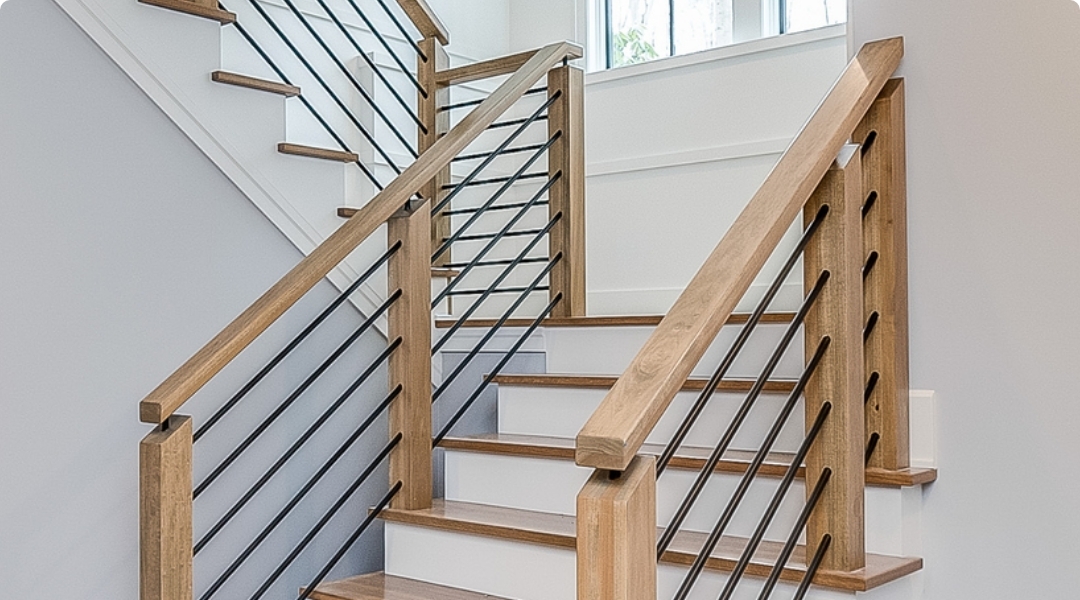
Wood remains the gold standard for residential handrails because of its tactile warmth. Unlike metal, which can feel shocking to the touch in a cold house, wood is inviting.
Hardwoods like Oak, Maple, or Walnut are preferred because they can be sanded to a perfectly smooth finish, essential for preventing splinters while sliding your hand along the rail.
However, wood profiles must be carefully routed to meet the Type I or Type II graspability codes; a rough-hewn timber might look rustic, but if it lacks a finger recess or smooth surface, it fails the support function.
Metal: Sleek And Durable
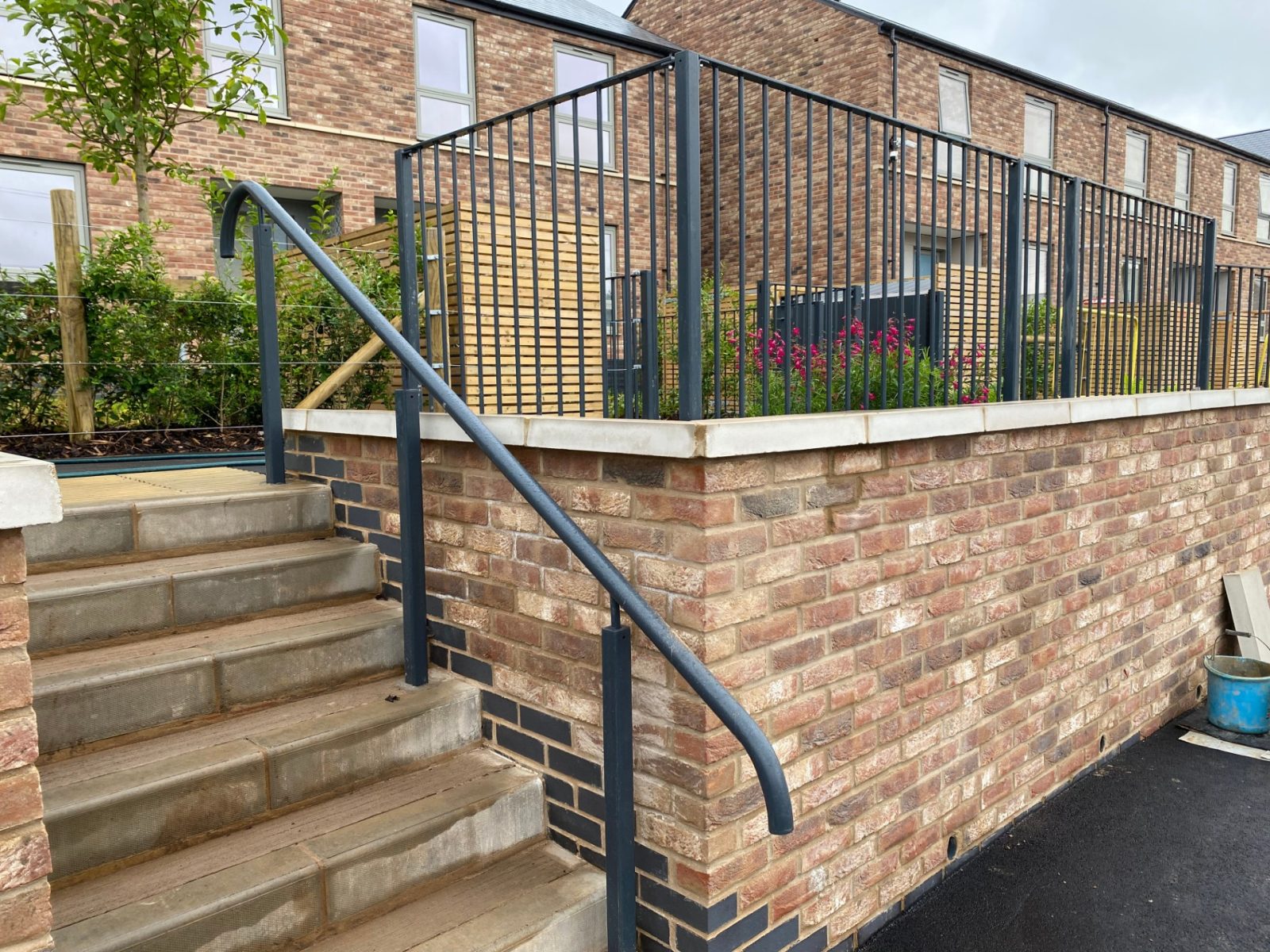
Metal handrailsare typically steel, stainless steel, or aluminum and offer a slimmer profile that is often easier to wrap a hand around than bulky wood.
In modern industrial or contemporary designs, a simple 1.5-inch round pipe is the perfect Type I compliant shape.
While metal is incredibly durable and maintenance-free, it can be cold to the touch and slippery if not finished with a matte or textured powder coat.
Wrought Iron: Custom Craftsmanship
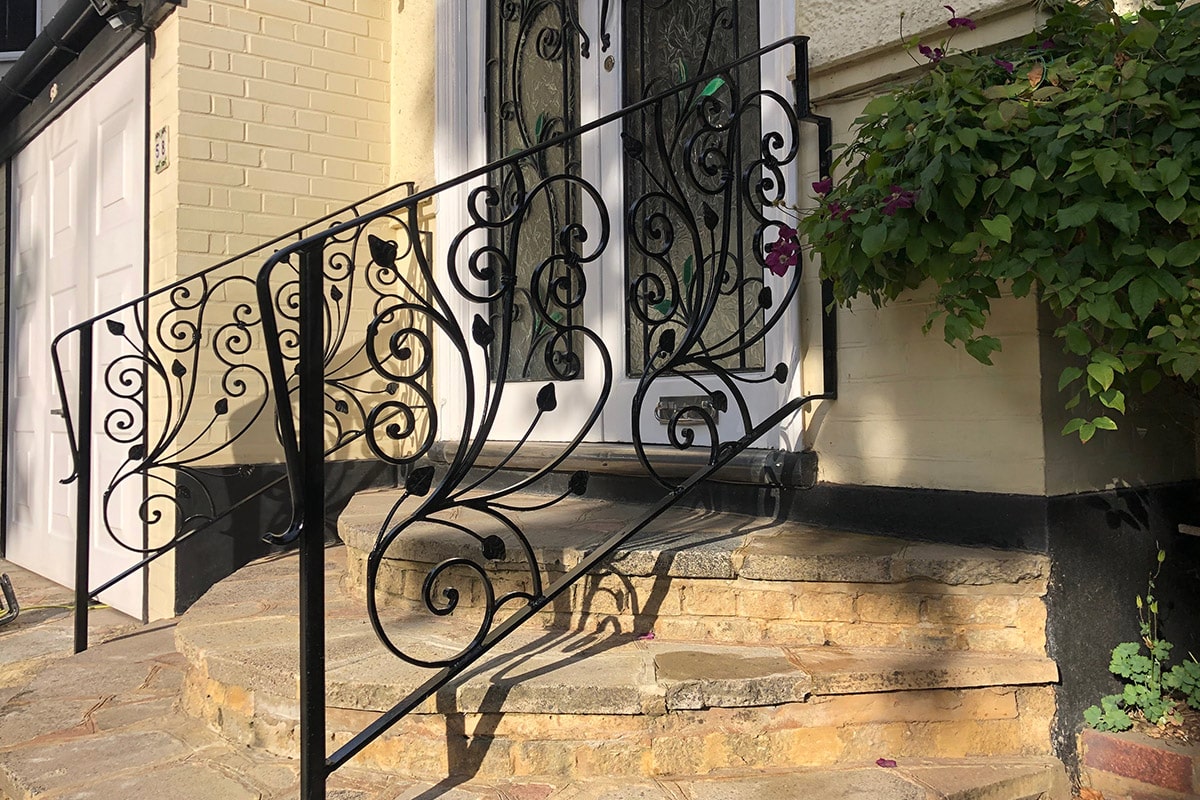
For Mediterranean or traditional homes, wrought iron offers the ability to create custom curves and volutes that wood cannot easily match.
The hammered texture of forged iron provides excellent friction for grip, preventing hands from slipping even if they are sweaty.
The trade-off is the surface texture; it must be finished carefully to ensure there are no sharp burrs that could snag clothing or scratch skin during a rapid descent.
Selecting The Right Guardrail Materials
Because the guardrail serves as a barrier, the material choice here is defined by strength and visibility.
Tempered Glass: Unobstructed Views
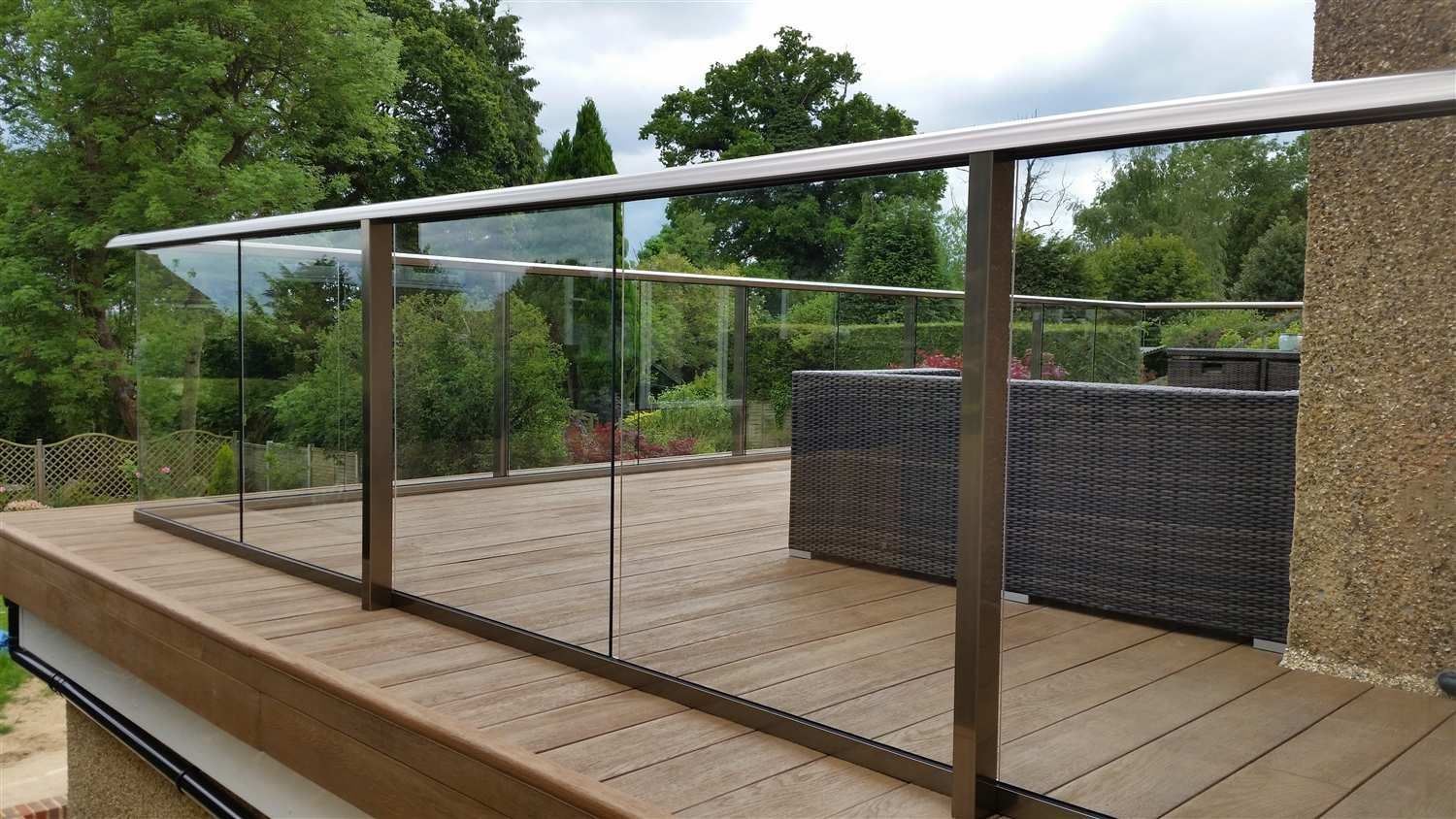
Glass is the premium choice for guardrails when the goal is to erase the barrier visually. We use tempered or laminated safety glass panels that act as the structural infill.
The major advantage is the complete lack of visual clutter-there are no balusters to block the sightline.
From a safety standpoint, glass is the ultimate child-proof solution because it creates a solid wall that is impossible to climb, completely satisfying the 4-inch sphere rule without complex measurements.
Stainless Steel Cable: Modern Minimalism
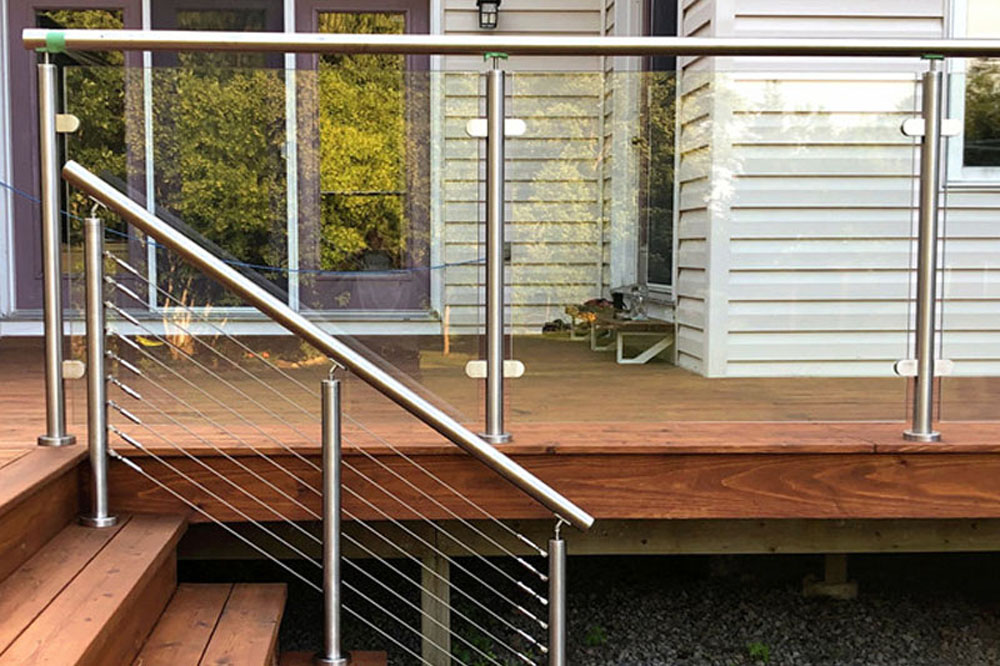
Cable railings have surged in popularity for their nautical, airy aesthetic. They replace vertical balusters with horizontal tensioned cables.
While they offer excellent sightlines, they are mechanically complex. The cables must be tensioned precisely to ensure they are rigid enough that a 4-inch sphere cannot be pushed through them.
Note that in some jurisdictions, horizontal cables are flagged for being climbable, so always verify local amendments before installation.
Wood Balusters: The Traditional Aesthetic
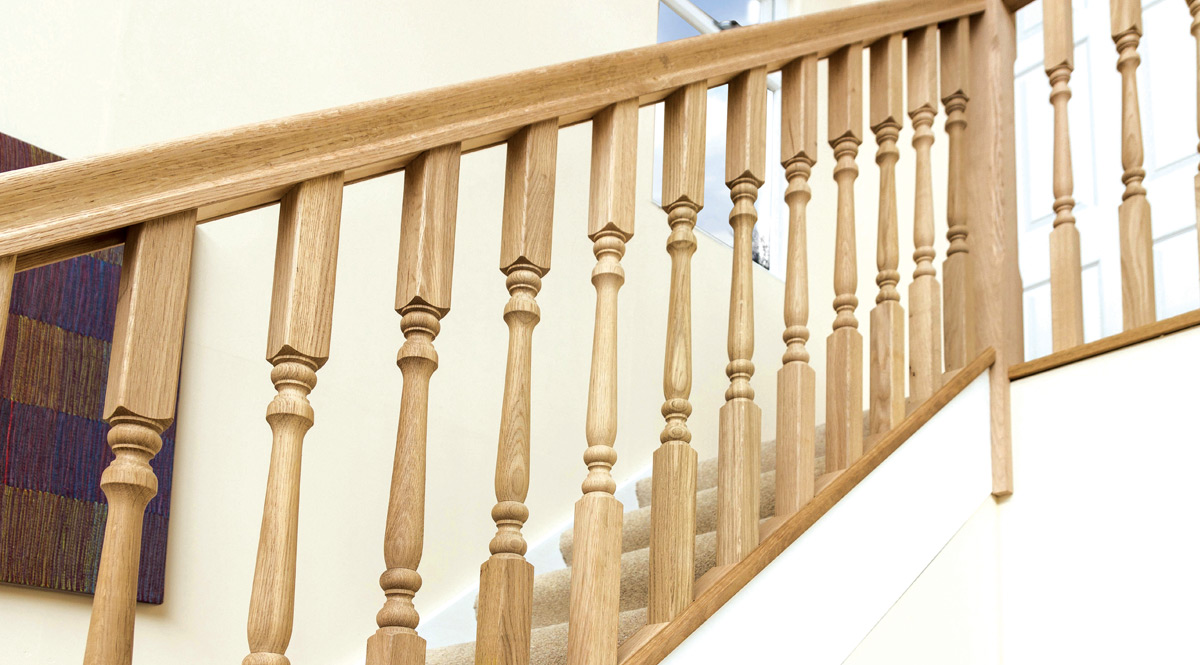
The classic vertical wood spindle (baluster) is the backbone of American residential design. It is structurally sound and easy to repair.
The key here is spacing; the balusters must be installed no more than 4 inches apart on center (usually closer) to ensure the gap between them meets code.
While cost-effective, wood guardrails require the most maintenance, as each spindle is a surface that collects dust and requires painting or staining.
Aluminum Pickets: Lightweight Strength
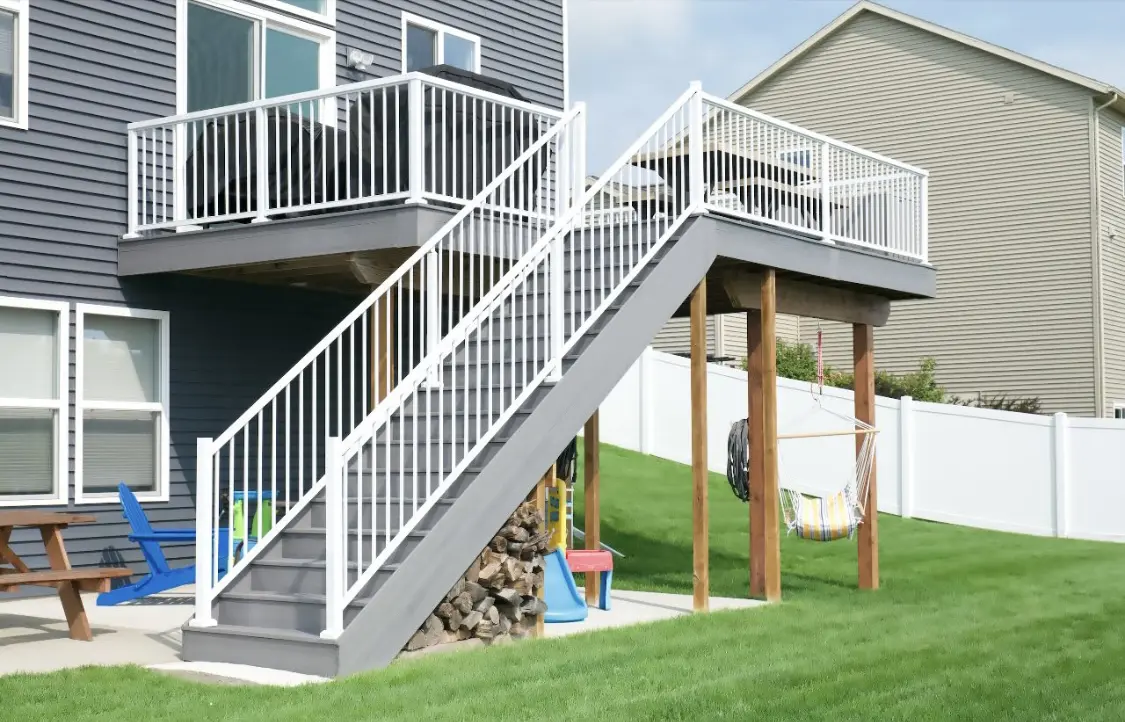
Prefabricated aluminum guardrail systems are rapidly replacing wood on exterior decks. They offer the vertical look of traditional pickets but with a fraction of the weight and zero rot risk.
Because they are factory-welded or mechanically fastened, the spacing is guaranteed to be code-compliant out of the box.
They are rigid, cool to the touch, and impervious to the weather, making them the pragmatic choice for long-term containment safety.
Aesthetic Considerations And Maintenance
Designing a staircase is a balancing act between the wow factor and the practical reality of daily life. The materials you choose for your handrails and guardrails define not just the look of your home, but the level of upkeep required to keep it safe.
Material Matters: Wood Vs. Metal Vs. Glass
From a design perspective, the choice of material dictates the visual weight of the stair.
- Wood:Classic and warm, wood offers excellent grip for handrails. However, it requires the most maintenance, regular sealing or painting to prevent oils from human hands from degrading the finish or, in exterior applications, to prevent rot that compromises structural integrity.
- Metal (Steel/Aluminum):These offer cleaner lines and higher strength with slimmer profiles, perfect for modern aesthetics. Powder-coated aluminum is particularly valuable for exterior guardrails as it resists rust and requires little more than a seasonal wipe-down.
- Glass & Cable:These are the go-to choices for maximizing views and light. However, they come with trade-offs. Glass guardrails require frequent cleaning to remove fingerprints and nose prints (from pets). Cable rails look sleek but require periodic tension checks to ensure they don't slacken and allow a 4-inch sphere to pass through.
The Maintenance-Safety Link
Maintenance is not just cosmetic; it is a safety issue. A loose handrail bracket or a wobbly newel post compromises the support function just when you need it most.
I recommend a shake test every six months: grab the rail and give it a firm shake. If there is movement at the connection points, tighten the hardware immediately.
Takeaway:Choose materials that match your lifestyle. If you aren't willing to polish glass or oil wood, opt for low-maintenance powder-coated metal to ensure long-term safety.
Achieving Safety And Innovative Design With Greco’s Railing Solutions
One of the most effective ways to solve the Design vs. Code conflict is to utilize engineered railing systems rather than attempting a custom site-built fabrication. This is where industry leaders like GRECO Architectural Metal Productsdistinguish themselves.
Engineered For Compliance
The primary advantage of specifying a system like GRECO’s is that the support vs. containment math has already been calculated.
Their aluminum and stainless steel systems are engineered to meet the 200-pound load requirements and strict dimensional codes of the IRC and IBC right out of the box.
This eliminates the risk of a carpenter inadvertently building a beautiful but non-compliant rail.
Versatility In Form
GRECO’s solutions allow for the seamless integration of safety and style. Whether you require the transparency of a glass railing system for a balcony guardrail or the rigid graspability of a continuous metal handrail for a stair flight, their systems offer modular adaptability.
They effectively tackle the Hybrid challenge, providing top rails that serve as guards while integrating secondary handrails that meet graspability standards, without sacrificing the sleek, architectural lines that modern residential design demands.
Takeaway:Leveraging a proven, engineered system like GRECO ensures that your project passes inspection on the first walkthrough, merging rigorous safety standards with high-end architectural aesthetics.
A Residential Decision Guide (Deck, Stairs, Loft, Windows)
Use this section to decide quickly, then confirm with your local building department or inspector for your jurisdiction.
2-Column Decision Table
| If your situation is… | You likely need… |
| A stair run with 4+ risers | Handrail (at least one side) |
| A deck/landing/balcony edge with a qualifying drop (often >30 within 36) | Guard |
| Open side of a stair (fall exposure) | Guard, and possibly combo guard/handrail |
| A top rail that you expect people to hold while descending stairs | It must meet handrail grip + continuity + height rules |
| You’re referencing OSHA for a home staircase | Treat OSHA as workplace-only guidance, not residential code |
The Hybrid Scenario: Can A Guardrail Be A Handrail?
This is the Support vs. Containment intersection. In many residential staircases, the open side needs both a barrier to prevent falls and a grip for support.
When Form Meets Function
Yes, the top of a guardrail can serve as a handrail, but it must satisfy both sets of rules simultaneously. This is difficult to achieve because:
- It must be between 34 and 38 high (which satisfies the guardrail 36+ minimum only if you keep it between 36 and 38).
- It must be graspable (Type I or Type II profile).
Design Challenges
Most standard guardrail caps are wide, flat boards (like a 2x4 or 2x6) intended to hold drinks or plants. These are not graspable.
If you want a wide cap on your guardrail, you must install a separate, graspable handrail attached to the inside of the guardrail at the correct height.
Takeaway:A Hybrid rail is efficient but leaves you a very narrow margin for error (36–38) and restricts your profile choices strictly to graspable shapes.
Key Code Distinctions
Understanding the why helps, but the what is non-negotiable during inspection. Here is where the numbers matter.
Height Wars: 34-38 Vs. 36+
This height discrepancy causes significant confusion.
- Handrails must be between 34 and 38 inches high. This is the ergonomic sweet spot for an adult to drop their hand and find support without bending over or reaching up.
- Guardrails must be a minimum of 36 inches high. There is no maximum height for a guardrail (you can build a 6-foot wall if you like), but it must meet the 36-inch minimum to prevent an average adult from toppling over it.
The Measurement Point
This is crucial:Where you measure from changes everything.
- Handrails are measured vertically from the sloped plane of the stair nosing (the very front edge of the tread).
- Guardrails are measured vertically from the flat finished floor or the line of the nosing.
Expert Insight:The Measurement Trap. I often see builders measure handrail height from the back of the tread rather than the nosing. On a steep stair, this can result in a rail that is 2-3 inches too low, leading to a failed inspection. Always measure from the nose.
Load Requirements
Both systems must be strong, but the expectation differs slightly. Both handrails and guardrails must be able to resist a single concentrated load of 200 pounds applied in any direction at any point along the top.
This ensures that if a large adult stumbles against the guard or leans heavily on the handrail, the structure will not fail.
Takeaway:Precision matters-measuring from the wrong spot or missing the height window by an inch can require a complete tear-out.
Common Residential Mistakes To Avoid
In my design reviews, I frequently redline these three specific errors.
1. The Wide Plank Error
Using a rectangular 2x4 or 2x6 as a handrail. While strong, it fails the graspability test. In an emergency, your hand cannot lock around it.
Fix:Use a routed profile with a finger recess or a standard round rail.
2. The Ladder Effect
Using horizontal cables or rails for the guardrail infill on a generic basis. While trendy, some local jurisdictions historically restricted this because it creates a ladder that children can climb.
Fix:While the 2021 IRC removed the restriction on climbable guards, some local amendments still ban them. Always check your specific municipal code before installing horizontal rails.
3. Discontinuous Handrails
Stopping the handrail at every landing or breaking it for a newel post without a transition.
Fix:The code requires the handrail to be continuous for the full length of the flight. Your hand should be able to slide from top to bottom without letting go.
Takeaway:Aesthetic trends, like wide flat rails or horizontal bars, must never override the physics of human safety.
Frequently Asked Questions
Can A Guardrail Be Used As A Handrail?
Yes, if the top rail meets handrail height and graspability requirements, and the assembly still meets guard rules where a guard is required.
Are Railing And Handrail The Same?
Not in building-code terms. Railing is an everyday umbrella word; a handrail is specifically the graspable support rail on stairs/ramps.
What’s The Difference Between A Guard Rail And A Guide Rail?
A guard rail/guard is a fall-prevention barrier; a guide rail typically guides motion (like elevator components or hardware tracks) and isn’t a fall barrier.
What Is The British Word For Guardrail?
In UK building guidance, you’ll often see guarding used as the functional term, with definitions around barriers and guarding in Approved Document K.
What Is The Typical Residential Handrail Height?
Many residential references place handrails at 34–38 inches above stair nosings (or ramp surface), but confirm locally.
What Is The Typical Residential Guardrail Height?
A common minimum for guards at open-sided walking surfaces is 42 inches, with stair-side exceptions in some cases.
What Does The 4-Inch Sphere Rule Mean?
It’s an opening limit used for guards in many residential rules: openings shouldn’t allow a 4-inch diameter sphere to pass through, with specific stair triangle allowances.
When Do Stairs Require A Handrail?
Many residential references require a handrail when a stair has four or more risers.
Why Does Osha Say Different Heights Than Residential Codes?
OSHA regulates workplaces, not private residences. It has its own criteria for guardrails and stair rail/handrail systems that can differ from residential code.
What Is A Handrail In Navigation?
In nautical contexts, a handrail can refer to rails you hold on a boat for stability-related purposes (support), but not the same as residential code terminology.
Do Handrails Need To Be Continuous?
Common residential guidance expects handrails to be continuous along the stair flight, with specific allowed interruptions (like certain newel/landing conditions).
How Strong Does A Residential Handrail Need To Be?
One residential handout states that handrails and supports should resist a 200-pound load applied in any direction at any point on the rail.
How Strong Does A Residential Guard Need To Be?
One residential handout notes a top rail load expectation of 50 pounds per lineal foot horizontally, plus other infill loading expectations.
Can A Deck Guardrail Be Lower If It Looks Safe?
No-guards have minimum height and opening requirements; aesthetics don’t replace those thresholds. Verify your local code adoption and inspection requirements.
Where Should I Verify The Requirements For My House?
Start with your local building department and the code edition they enforce; municipal handouts often summarize the exact triggers they inspect against.
Coclusion
The distinction between handrail and guardrail is not just semantic; it is the difference between a helpful grip and a protective wall. As you plan your project, remember the core mantra: Handrails support the hand; Guardrails contain the body.
By respecting the graspability of the handrail and the geometry of the guardrail, you ensure your home is safe for every generation that walks through it. Do not fear the code; use it as the baseline for a design that works as beautifully as it looks.
Jump to
Support Vs. Containment: Understanding Handrail Vs. Guardrail Differences
Key Takeaways
Quick Reference: Handrail Vs. Guardrail Standards
Defining The Terms: What Is A Handrail?
Defining The Terms: What Is A Guardrail?
Selecting The Right Handrail Materials
Selecting The Right Guardrail Materials
Aesthetic Considerations And Maintenance
Achieving Safety And Innovative Design With Greco’s Railing Solutions
A Residential Decision Guide (Deck, Stairs, Loft, Windows)
The Hybrid Scenario: Can A Guardrail Be A Handrail?
Key Code Distinctions
Common Residential Mistakes To Avoid
Frequently Asked Questions
Coclusion

George Evans
Author
George Anderson, an exceptional architectural designer, envisions and brings to life structures that transcend the realm of imagination. With an unwavering passion for design and an innate eye for detail, George seamlessly blends form and function, creating immersive spaces that inspire awe.
Driven by a deep appreciation for the interplay of space, light, and materials, George's innovative approach redefines the possibilities of architectural design. His visionary compositions leave an indelible mark, evoking a sense of wonder and transforming the built environment.
George Anderson's transformative designs and unwavering dedication continue to shape the architectural landscape, pushing the boundaries of what is possible and inspiring generations to come.
Latest Articles
Popular Articles